Probate Court Confirmation Documents

Probate sales are a different animal. If you've only ever worked standard residential transactions, your first probate can feel like you've been dropped into a legal proceeding with a real estate transaction bolted onto the side. Because that's basically what it is. The Probate Court Confirmation process applies when a property is part of a deceased person's estate and the personal representative (executor or administrator) doesn't have full authority under the Independent Administration of Estates Act (IAEA) to sell without court oversight. When full IAEA authority is absent, the court steps in to confirm the sale, and that changes everything about how your transaction runs.

Why This Document Matters

Real talk: probate court confirmation isn't optional paperwork. It's a legal requirement, and without it, the sale doesn't close. Full stop.

When a property falls under court-supervised probate, no deed can transfer, no escrow can fund, and no commission gets paid until a judge signs off. The court exists to protect the estate's beneficiaries and creditors, making sure the property isn't sold for less than fair market value. That protective function is the reason the overbid process exists, and it's the reason your buyer needs to understand what they're walking into before they write an offer.

For agents, the risk isn't just delays. Missing a court date or misunderstanding the confirmation timeline can kill the deal entirely, leave your buyer exposed, and create liability you don't want. If you want a deeper look at how transaction complexity like this creates problems, this breakdown of common TC mistakes is worth reading before your first probate.

How It Works

The short version: the personal representative accepts an offer, then petitions the court to confirm the sale. The court sets a hearing date. At the hearing, other buyers can show up and overbid. If nobody overbids, the original buyer gets the property. If someone does overbid successfully, your original buyer is out.

Here's how the timeline typically flows in California:

  • The personal representative, working with a probate attorney, accepts an initial offer
  • A Petition to Sell Real Property is filed with the probate court
  • The court schedules a confirmation hearing, typically 30 to 45 days out (sometimes longer depending on court calendar)
  • Notice of the hearing is published and served to interested parties
  • At the hearing, the court opens the floor to overbids following specific minimum bid increments set by California law
  • If the sale is confirmed, the court issues a Court Order Confirming Sale
  • Escrow receives the order and can proceed to close

The California Department of Real Estate and probate courts operate on their own timelines. You are not closing in 30 days on a court-supervised probate sale. Build in 60 to 90 days minimum, and communicate that clearly upfront.

Key Sections Explained

Petition to Sell Real Property

This is the document the personal representative's attorney files to initiate court confirmation. It describes the property, the terms of the accepted offer, the proposed commission, and why the sale is in the estate's best interest. You'll often need to provide documentation supporting the sale price, including the listing history or a broker price opinion.

Court Confirmation Hearing Notice

The court issues a notice of the hearing date and time. This notice has to be properly served and, in many cases, published in a local newspaper of general circulation. If this step gets fumbled, the hearing gets continued, and your timeline takes another hit.

Overbid Procedures

California probate law under Probate Code Section 10311 sets minimum overbid amounts. The first overbid must be at least the original offer price plus 5% of that price, plus $500. Any bidder who shows up to the hearing must come with a cashier's check for the required deposit, ready to bid. This isn't theoretical. Overbids happen, and unprepared buyers get blindsided.

Court Order Confirming Sale

Once the judge approves the sale, either to the original buyer or a successful overbidder, the court issues a signed order. This order goes to escrow and acts as the legal authorization to close. Without it, escrow cannot fund.

Commission Approval

The court also reviews and approves the commission as part of the confirmation process. Commission structures in probate sales are sometimes set by local court rules or negotiated within the petition. Don't assume your standard commission agreement controls here. The court has the final word.

Common Mistakes to Avoid

Underestimating the timeline. Agents who quote standard 30-day escrow timelines on probate listings do real damage to client expectations. California escrows are already running longer than they used to, and probate adds another layer on top. Set the right expectations from day one.

Missing court dates. The hearing date is not like a contingency removal deadline you can push with a quick email. If the personal representative or their attorney misses the hearing, the court may dismiss the petition and you start over. Track this date like it's the most important deadline in your file, because it is. Deadline management on a probate transaction needs to be airtight.

Not preparing your buyer for overbidding. This is the one that creates the most unhappy surprises. Your buyer spent 45 days in escrow, got emotionally attached to the property, skipped other offers, and now they're sitting in a courtroom watching someone else buy it. That outcome is avoidable if you prepare them. Explain the overbid process before they write the offer, not after.

Getting commission wrong. If the commission listed in the petition doesn't match what you agreed to, and the court approves the petition as filed, you may not have recourse. Review the petition carefully before it's filed.

Working without a probate attorney. The personal representative needs one. You need to be working alongside one. This is not a transaction you manage solo with a standard purchase agreement.

Pro Tips from a TC

Work backward from the court date, not from the close of escrow. Once you know the hearing date, every other deadline in your file organizes around it.

Get your buyer's cashier's check ready before the hearing. If your buyer wants to protect against an overbid, they need to be prepared to counter at the courthouse. That means having funds available and understanding exactly how much they're willing to go to.

Initial deposits on probate sales are often higher than standard transactions. Typically 10% is expected at offer, and the personal representative may require a cashier's check rather than a personal check. Know this before your buyer writes the offer.

Ask the probate attorney early whether the estate has full IAEA authority or limited authority. If it's full authority, you may not need court confirmation at all, and your transaction can proceed more like a standard sale. This one question can save weeks.

Commission on the buyer's side in a probate sale may be addressed in the petition and subject to court approval. If you're the buyer's agent, confirm how compensation is being handled before your client is deep into the transaction. The BRBC overview can give you context on how compensation agreements interact with situations like this.

For listings involving an estate property, our listing management services can help keep the coordination side organized while the legal process runs its course.

Related Documents

Frequently Asked Questions

Q: Can a probate sale fall through after court confirmation?

Yes, though it's uncommon. If the confirmed buyer backs out after the court order, the estate typically retains the deposit and has to restart the process. Depending on how much time has elapsed, another petition may need to be filed. Some probate courts will allow the personal representative to accept the next highest bid from the confirmation hearing without a new petition, but that depends on the judge and the specific circumstances. The personal representative's attorney handles this, not the agents.

Q: Do standard CAR disclosures still apply in a probate sale?

Partially. The personal representative is generally required to disclose what they actually know about the property, but they aren't held to the same standard as a seller who lived in the home. The Transfer Disclosure Statement (TDS) may be exempt if the personal representative qualifies for the exemption under California Civil Code Section 1102.2. That said, the AVID, natural hazard disclosures, and other seller-side disclosures often still apply. Your probate attorney and disclosure coordination process should sort through which forms are required for the specific transaction.

Q: What happens if my buyer wants to back out during the probate escrow period before the hearing?

Before the court confirmation hearing, the buyer's ability to cancel depends on the terms of the accepted offer and any applicable contingencies in the purchase agreement. A probate purchase addendum typically modifies the standard cancellation and contingency terms. If contingencies haven't been removed, the buyer may have the ability to cancel without forfeiting their deposit. Once the court confirms the sale, the buyer is much more committed. This is exactly why buyer preparation matters early, and why understanding contingency removals in the context of a probate transaction is worth reviewing before you get there.

Probate transactions aren't the kind of file you want to wing with a standard checklist. If you're managing one alongside a regular book of business, the coordination load is real. That's where a virtual TC service like Relaxed Agent can carry the tracking, deadline management, and document organization while you focus on your client and the legal process.

**California real estate forms change more often than you'd think. CAR updates forms, new laws come into effect, and disclosure requirements shift. We do our best to keep this library current, but always cross-reference with your broker or the California Association of Realtors before relying on anything here for a live transaction. Something look off? Drop us a line and we'll fix it fast.

Learn About Other Documents

Buyer's Final Walk-Through Verification

Also Known As:
BFTV
Agreement

A form confirming the buyer inspected the property one final time before closing and found it in the agreed-upon condition, with any agreed repairs completed.

Learn More

HOA Documents

Also Known As:
HOA
Disclosure

A package of documents from the homeowners association including CC&Rs, bylaws, financial statements, meeting minutes, and any pending special assessments.

Learn More

Deed of Trust

Also Known As:
DOT
Agreement

The security instrument recorded alongside the Grant Deed that gives the lender the right to foreclose on the property if the buyer defaults on their loan.

Learn More
Discover Popular

Real Estate Tools

Hotjar
Website

Hotjar

Hotjar is a user behavior analytics tool that helps real estate agents optimize their websites by tracking visitor interactions, heatmaps, and feedback.

Heading 1

Heading 2

Heading 3

Heading 4

Heading 5
Heading 6

Lorem ipsum dolor sit amet, consectetur adipiscing elit, sed do eiusmod tempor incididunt ut labore et dolore magna aliqua. Ut enim ad minim veniam, quis nostrud exercitation ullamco laboris nisi ut aliquip ex ea commodo consequat. Duis aute irure dolor in reprehenderit in voluptate velit esse cillum dolore eu fugiat nulla pariatur.

Block quote

Ordered list

  1. Item 1
  2. Item 2
  3. Item 3

Unordered list

  • Item A
  • Item B
  • Item C

Text link

Bold text

Emphasis

Superscript

Subscript

More Details
Elfsight
Website

Elfsight

Elfsight offers user-friendly widgets like contact forms, reviews, and social feeds to boost engagement and enhance your real estate website. No coding needed.

Heading 1

Heading 2

Heading 3

Heading 4

Heading 5
Heading 6

Lorem ipsum dolor sit amet, consectetur adipiscing elit, sed do eiusmod tempor incididunt ut labore et dolore magna aliqua. Ut enim ad minim veniam, quis nostrud exercitation ullamco laboris nisi ut aliquip ex ea commodo consequat. Duis aute irure dolor in reprehenderit in voluptate velit esse cillum dolore eu fugiat nulla pariatur.

Block quote

Ordered list

  1. Item 1
  2. Item 2
  3. Item 3

Unordered list

  • Item A
  • Item B
  • Item C

Text link

Bold text

Emphasis

Superscript

Subscript

More Details
LeadPages
Lead Gen

LeadPages

LeadPages is a landing page builder designed to create high-converting pages for lead generation. With drag-and-drop templates, they make it a breeze.

Heading 1

Heading 2

Heading 3

Heading 4

Heading 5
Heading 6

Lorem ipsum dolor sit amet, consectetur adipiscing elit, sed do eiusmod tempor incididunt ut labore et dolore magna aliqua. Ut enim ad minim veniam, quis nostrud exercitation ullamco laboris nisi ut aliquip ex ea commodo consequat. Duis aute irure dolor in reprehenderit in voluptate velit esse cillum dolore eu fugiat nulla pariatur.

Block quote

Ordered list

  1. Item 1
  2. Item 2
  3. Item 3

Unordered list

  • Item A
  • Item B
  • Item C

Text link

Bold text

Emphasis

Superscript

Subscript

More Details
Heygen
AI

Heygen

HeyGen is an AI video creation platform that lets you build professional videos using a digital avatar. No camera, no crew, just you on screen looking polished.

Heading 1

Heading 2

Heading 3

Heading 4

Heading 5
Heading 6

Lorem ipsum dolor sit amet, consectetur adipiscing elit, sed do eiusmod tempor incididunt ut labore et dolore magna aliqua. Ut enim ad minim veniam, quis nostrud exercitation ullamco laboris nisi ut aliquip ex ea commodo consequat. Duis aute irure dolor in reprehenderit in voluptate velit esse cillum dolore eu fugiat nulla pariatur.

Block quote

Ordered list

  1. Item 1
  2. Item 2
  3. Item 3

Unordered list

  • Item A
  • Item B
  • Item C

Text link

Bold text

Emphasis

Superscript

Subscript

More Details
TIPS & INsights

Read Our Latest Articles

View All Articles
still life photograph of two mismatched puzzle pieces on a plain wooden surface

Loan Officer Partnerships: The Lead Source You Skip

Aug 7, 2026
5 min read

Your phone is full of loan officers who want to grab coffee sometime. Here is how to turn one of them into a real referral partner, not a wasted contact.

Loan Officer Partnerships: The Lead Source You Skip

Every Lender Pitch You've Ignored Says the Same Thing

You have a stack of business cards from loan officers who bought you a coffee once. Maybe a lunch. They said something about "partnering up" and "sending each other business," and you nodded, because that's what you do when someone else is paying for your sandwich. Then you never spoke to them again.

Meanwhile you're spending real money on portal leads that half answer their phone and ghost you after showing three houses. Somewhere in your contacts is a person whose entire job depends on the same buyers you're chasing, and you've filed him under "networking, maybe."

That's the gap. Not a lack of leads. A lack of follow through on a lead source that's already sitting there, pre qualified, motivated, and structurally aligned with your business in a way Zillow will never be.

portrait photograph of a real estate agent and a loan officer at a small table inside a neighborhood coffee shop

Why Referrals Still Run This Business

Here's the part agents forget when they're deep in a Facebook ad spend spiral. According to the National Association of Realtors, forty three percent of buyers found their agent through a referral, and eighteen percent used an agent they had already worked with. That's the majority of buyer side business coming from relationships, not clicks. Read the full breakdown from NAR if you want the rest of the numbers.

A loan officer talks to prospective buyers earlier than you do, in almost every case. Someone gets serious about buying, they start with a pre approval conversation, and only after that do they start touring homes with an agent. That means a good loan officer sees your future client before you do. If that loan officer has three agents they trust and you're not one of them, you're losing deals you never even knew existed.

This isn't a replacement for your past clients as a lead source or the warm referral system you're already running. It's an addition. A parallel pipeline that requires almost no ad spend and, done right, sends you people who are already financially vetted before you ever get a call.

The Line You Cannot Cross

Before you go set up a "partnership," you need to understand the boundary, because this is where agents get themselves and their lenders into real trouble.

RESPA Section 8 prohibits paying or receiving kickbacks for referring settlement service business, and that includes mortgage referrals. You cannot take a fee for sending someone to a specific loan officer. You cannot split commissions for referrals. And marketing arrangements that look like a co-branded newsletter or a shared open house sign but are actually structured as payment for referrals have landed both lenders and brokerages in consent orders with civil penalties in the hundreds of thousands to millions of dollars.

The CFPB's own compliance FAQ on RESPA is worth an actual read, not a skim, especially the section on marketing services agreements. The short version: you can co-market. You can split the cost of an ad that promotes both of you equally. You cannot pay, or be paid, for the referral itself, and you cannot structure a marketing deal that's secretly a referral fee with extra paperwork.

California agents also answer to the DRE's broker relationship rules, so if you're unsure whether an arrangement crosses a line, that's a conversation for your broker or a real estate attorney, not a guess based on what your last brokerage let you get away with.

What an Actual Partnership Looks Like

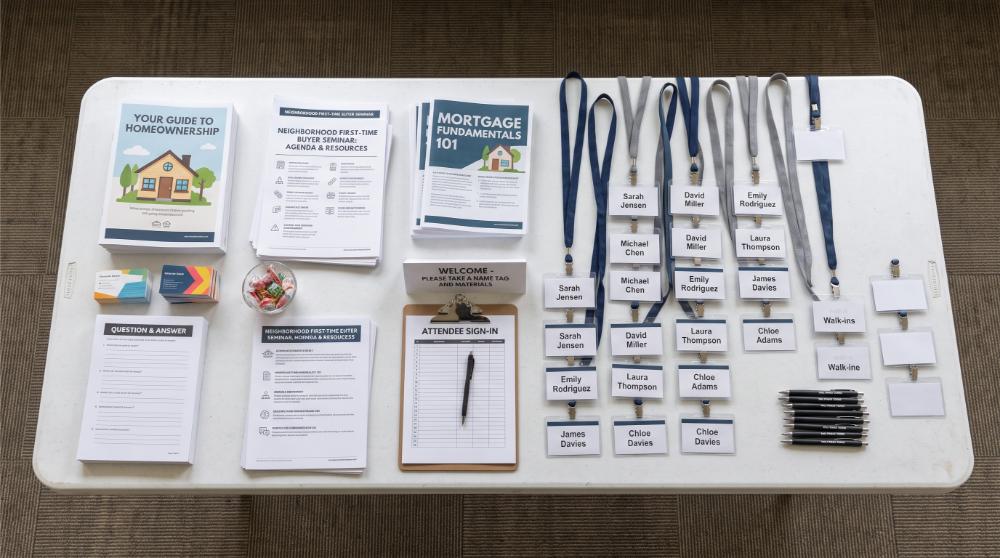
Strip out anything that resembles payment for referrals and you're left with a surprisingly wide field. Co-hosted first-time buyer seminars where you split the venue cost and both speak. Joint content, like a monthly email that goes to both of your databases with genuinely useful information, not a thinly veiled ad. A shared print piece for a neighborhood mailer, similar in spirit to the kind of mailer that doesn't get thrown out, but co-branded and cost split evenly.

You can refer clients to each other based on trust and track record, full stop, with no fee attached in either direction. That's not a loophole. That's the entire point. The relationship has to be valuable on its own merits, not propped up by money changing hands under the table.

flat-lay photograph of a folding table set up for a neighborhood first-time buyer seminar, printed handouts and name tags arranged on the table

Finding a Loan Officer Worth Partnering With

Most agents pick a lender the way they pick a barber. Whoever's closest, whoever a friend mentioned once. That's backwards for a relationship you're hoping to build for years.

Look at how fast they respond to pre approval requests on nights and weekends, because your buyers don't stop looking at houses after 5pm and neither should their financing person. Ask other agents who they actually trust, not who sends the nicest holiday card. Watch how they handle a file that gets complicated, a self-employed buyer, a low appraisal, a rate lock that's about to expire mid-escrow. The loan officers worth keeping are the ones who call you with bad news early instead of letting it surface three days before closing.

If you already work with a transaction coordinator, ask them who they've seen handle deadlines well. TCs see loan officers at their best and worst more than almost anyone, because managing the lender relationship is part of what keeping a file on track actually requires. That's not a bad source of intel.

Building the Relationship Without Making It Weird

Don't lead with "let's send each other business." That's the fastest way to make someone feel like a transaction instead of a partner, and it also edges uncomfortably close to the RESPA line if either of you starts treating the arrangement as quid pro quo.

Lead with something useful instead. Send them a client who needs financing, with zero expectation attached, and see what they do with it. Do that two or three times before you ever have "the conversation" about formalizing anything. Trust built through actual behavior beats a handshake agreement every time, and it protects both of you if anyone ever asks how the relationship works.

Keep the cadence low pressure. A quarterly check-in call, a shared lunch twice a year, a text when you see market news relevant to both of you. This isn't a courtship. It's a long, quiet accumulation of reasons to trust each other, the same way a lead magnet earns trust before it earns a client rather than demanding one upfront.

photograph of overlapping ripples in still water at close range, warm natural light reflecting off the surface

When the Loan Officer Becomes the Weak Link

Here's the part nobody wants to admit. Sometimes the loan officer is the reason a deal falls apart. Slow to respond. Vague about conditions. The kind of person who says "we're on track" until the day before closing, when suddenly they're not.

If that's happening more than once, it's not bad luck. It's information. Track it the way you'd track any lead source that isn't converting, because a referral partner who costs you deals is worse than no partner at all. A CRM that actually shows you deal-level notes tied to each partner helps here, and if your CRM is currently collecting dust instead of tracking this kind of thing, that's a separate problem worth fixing.

This is also where a transaction coordinator earns their fee twice over. A good TC keeps the pressure on every party in the file, lender included, so a slow loan officer gets caught in week two instead of week six. If you're managing ten files solo and can't tell which of your lender partners is quietly costing you closings, that's usually a sign you're past due for help.

Make the Referral a Two Way Street

The partnerships that last are the ones where both people are actually sending business, not just one person hoping the other remembers them at the right moment. If you're only ever the one receiving, the relationship has an expiration date, because the loan officer will eventually find an agent who sends deals back.

Look at your own preferred vendor list and be honest about whether it's a real resource or a graveyard of names you collected once. A short, curated list of two or three loan officers you genuinely trust, that you send to every client who needs financing, is worth more than fifty contacts you can't tell apart.

If you want to see how Relaxed Agent fits into the file once financing, disclosures, and deadlines all start moving at once, take a look at what our team actually handles or just reach out and ask us directly. We're not selling you a lender relationship. We're the people making sure the one you already have doesn't blow up your escrow.

Next time a loan officer buys you coffee and mentions partnering up, don't nod and forget. Send them a client. See what they do with it. That's the whole test.

Read Article
a cursor icon hovering over a single button on a webpage, shallow depth of field

Should Your Website Have a Dedicated Expired Seller Landing Page?

Aug 2, 2026
5 min read

Generic contact forms lose expired sellers fast. Here is whether a dedicated landing page actually converts better, and how to build one that does.

The Expired Seller Who Bounced Off Your Homepage

Picture the moment. A seller whose listing just expired gets a text from you with a link. They click it, and it drops them on your homepage, the same one every buyer, every seller, every curious neighbor lands on. A hero image, a search bar, a generic "contact me" button buried in a menu. They close the tab in four seconds. You just spent real effort finding that lead and lost them to a page that wasn't built for the moment they were actually in.

That's the gap a dedicated landing page closes. Not because it's fancier. Because it's specific.

photograph of a laptop screen showing a simple, uncluttered webpage layout

Landing Pages Don't Win Because They're Prettier

They win because they do one thing. Landing pages built around a single call to action convert at roughly 5 to 15 percent, compared to a typical real estate homepage converting somewhere between 0.5 and 1.5 percent. That's not a small gap. That's the difference between a lead source that's actually working and one that's quietly wasting your ad spend or your text campaign's effort.

For seller-specific pages built around a strong, targeted offer, like an instant home valuation or a market report tailored to their exact situation, best-in-class conversion rates run 15 to 34 percent when the traffic is warm or hyper-targeted. An expired seller you just texted is about as warm and targeted as traffic gets. Sending that person to a generic homepage is leaving most of that conversion potential on the table.

We covered the core version of this argument in landing pages vs your homepage. This is the same principle applied to a much narrower, much more valuable audience.

What an Expired Seller Actually Needs to See

A generic seller landing page talks about you. An expired seller landing page needs to talk about what happened to them. That distinction changes almost everything about the copy and layout.

  • Lead with acknowledgment, not a pitch, something closer to "Your home didn't sell. Here's why that happens and what changes it" rather than a headline about your team's accolades
  • Offer something specific and useful in exchange for contact information, a breakdown of common reasons listings expire, or a free updated market analysis, not a generic newsletter signup
  • Keep the form short. Name, phone, property address. Every extra field is a reason to bounce, and your contact page is probably already losing clients for exactly this reason
  • Cut the navigation menu entirely. A strong landing page eliminates distractions on purpose, no sidebar links, no way to wander off to your listings page mid-decision
  • Include a specific, low-pressure next step. A short video walking through what you'd do differently converts better than a wall of testimonials nobody reads before they've decided to trust you
real estate agent recording a short video on a phone tripod in a home office

Why the Homepage Actually Fails This Specific Visitor

Your homepage is built to serve every visitor at once, which means it serves the expired seller worst of all. They're not browsing. They're evaluating whether you're worth a callback after a bad experience. A homepage designed for broad discovery, buyer search bars, featured listings, general branding, forces them to hunt for relevance they should have gotten in the first three seconds.

This is the same failure mode we described in why sellers leave your website without calling and are you sending website visitors to the wrong page. An expired seller clicking a generic link is the clearest possible example of a visitor sent to the wrong page. You already know why they're there. Build the page to match.

The Traffic Source Matters More Than the Page Design

None of this works if the traffic getting to the page isn't actually warm. If you're pairing this with expired listing detection tools that get you the seller's information fast, the landing page is where that speed advantage actually converts into a lead you can work. A slow lead sent to a great landing page still underperforms. A fast lead sent to a mediocre one does too. You need both pieces working together, which is exactly the point made in our post on why expired listings convert better than any other lead source. The page is the last step in a chain that starts with speed.

A multi-channel approach, text, mail, a landing page link included in both, tends to outperform any single channel alone, because different sellers respond to different formats. But every channel should point to the same purpose-built page, not a scattered mix of homepage links and generic contact forms.

a phone screen showing a short text message conversation thread, held at an angle with shallow depth of field

What This Costs You to Build

This doesn't require a website overhaul. Most Webflow setups can duplicate an existing seller page template, strip the navigation, swap the headline and offer, and be live within an afternoon. The mistake agents make isn't technical difficulty. It's treating this as optional polish instead of the actual mechanism that turns a warm lead into a booked appointment. Landing page examples worth studying tend to share the same bones, a focused headline, one visible call to action, and nothing else competing for attention.

If you've already built a strong homepage that converts general visitors, don't dismantle that work. Just stop asking it to do a job it was never built for. Your homepage sells you broadly. Your expired seller landing page needs to sell one specific promise to one specific person who's already decided to sell and just needs a reason to trust someone new.

So check where your expired seller texts and mailers are actually pointing right now. If it's your homepage, that's the fastest fix available to you this week.

Read Article
photograph of a phone screen showing a missed call notification icon, held at an angle rather than flat

Which CRM Actually Flags Expired Listings Fast Enough to Matter

Jul 30, 2026
5 min read

BoldTrail, Follow Up Boss, and Lofty are not built to catch expireds fast. Here is what actually alerts you before other agents call first.

Your CRM Is Not Watching the MLS the Way You Think It Is

Here's an uncomfortable truth if you've been counting on your CRM to flag expired listings for you. It probably isn't, not the way you need it to. BoldTrail, Follow Up Boss, and Lofty are excellent at nurturing leads once you have them. They're built to send your contacts new listings, price drops, and market snapshots. None of them were designed from the ground up to tell you, the agent, the moment a listing status flips to expired so you can be the first call, not the sixth.

That gap is exactly why an entire industry of specialized data providers exists, and why the agents winning expired listings consistently aren't necessarily running better CRMs. They're running a different tool stack entirely.

photograph of a smartphone displaying a notification screen resting on a car dashboard

What Your General CRM Actually Does

BoldTrail's Search Alerts are built to notify your contacts about new listings, price reductions, and off-market changes that match a saved search. That's client-facing lead nurture, not agent-facing prospecting. Follow Up Boss has a similar MLS property update email feature, again aimed at keeping your leads warm with fresh listings, not flagging expireds for you to call. Lofty's Property Alerts and Market Snapshots follow the same pattern, useful for keeping buyers and sellers engaged, not built as a same-day expired detection system.

None of that is a knock on these platforms. They're doing exactly what they were designed to do. It's just not what you need if your goal is being the first call a frustrated seller gets after their listing dies. If you've been frustrated that your CRM feels like it's collecting dust, this might be why. You're asking a lead nurture tool to do a prospecting tool's job.

What Actually Catches Expireds Fast

The platforms built specifically for this are REDX, Vulcan7, and Landvoice, and they work fundamentally differently than your everyday CRM. Instead of watching your saved searches, they pull directly from MLS data to detect status changes, expired, withdrawn, canceled, often skip-tracing contact information at the same time so you're not just getting an address, you're getting a phone number attached to it.

According to industry comparisons, agents using dedicated expired listing automation reach sellers meaningfully faster than agents relying on manual MLS checks, and convert at a noticeably higher rate as a direct result. Inman's technology survey found roughly a third of agents actively prospecting expireds use REDX as their primary data source, which tells you where the market has already voted with its subscription dollars.

real estate agent sitting in a parked car with a phone to their ear, notebook open on the passenger seat

REDX vs Vulcan7 vs Landvoice, Quickly

None of these are free, and none of them are trying to be your whole CRM. Here's roughly how they differ:

  • REDX is generally the most affordable entry point, pulls expireds, FSBOs, and pre-foreclosures, and pairs with its own multi-line dialer so you're not switching tools mid-call
  • Vulcan7 tends to run more expensive but is frequently praised for contact data accuracy, and includes its own built-in CRM and dialer for agents who want fewer moving parts
  • Landvoice differentiates with Call Capture, which gives you toll-free tracking numbers and instant call alerts tied to your offline marketing, useful if you're running mail alongside your calls

None of these replace BoldTrail, Follow Up Boss, or Lofty. They feed them. The workflow that actually works looks like this: the data provider flags the expired listing and gets you a number fast, you make the call, and once you've got a real conversation going, the lead moves into your actual CRM for the nurture sequence, the drip campaign, the transaction paperwork down the line. Trying to make one tool do both jobs is usually where agents get stuck.

Why Speed Is the Entire Point

If you read our post on why expired listings convert better than any other lead source, you already know the seller who gets called within 24 hours of expiration is in a very different headspace than the one who's fielded calls from five agents by day three. That timing window is the entire value proposition of these specialized tools. A CRM checking your saved MLS search once a day isn't fast enough. A platform built to detect the status change and hand you a phone number within hours is a different category of tool entirely.

This is the same logic behind what Zapier can do for a solo agent with no admin support. Sometimes the fix isn't a bigger platform, it's the right narrow tool plugged into the system you already have. Building a Zapier bridge between an expired data feed and your CRM's contact database can save you the manual re-entry that eats up the exact minutes that matter most.

If You're Comparing CRMs for This Specific Reason, Stop

If the whole reason you're evaluating BoldTrail against Follow Up Boss is expired listing speed, that's the wrong comparison to be running. Neither one is built to win that race. The comparison that actually matters is REDX versus Vulcan7 versus Landvoice for lead detection speed and data accuracy, paired separately with whichever CRM already fits how your team nurtures leads day to day. Two different decisions, often conflated into one.

If you're brand new and budget is tight, this is also worth weighing against what's covered in the best free tools for agents just starting out. REDX in particular tends to be the lower cost entry point among the three, which matters if you're testing whether expired prospecting fits your business before committing to a pricier stack.

photograph of a printed contact list with a highlighter mark next to one entry

The Feature Nobody's CRM Advertises

Here's the honest summary. There is no single CRM feature that solves this, because expired listing speed was never the problem BoldTrail, Follow Up Boss, or Lofty set out to solve. That's not a flaw in those platforms. It's a mismatch in expectations. The CRM feature nobody uses that would actually save you time here doesn't live inside your CRM at all. It lives in a dedicated data feed sitting upstream of it.

So before you spend another hour comparing CRM dashboards looking for an expired listing alert that isn't coming, ask a different question. Do you have a tool that tells you the moment a listing dies, or are you still refreshing the MLS yourself and hoping you're first?

Read Article
photograph of a real estate agent's hand circling an address on a printed listing sheet with a pen

The Highest-Converting Leads Agents Keep Ignoring

Jul 27, 2026
5 min read

Expired listings convert better than any other lead source in 2026. Here is how to find them, approach sellers with empathy, and win the re-list.

The Lead Source Sitting in Your MLS Right Now

You're spending money on portal leads that convert somewhere between one and four percent. Meanwhile there's a homeowner three miles away who just watched their listing expire, already decided to sell, already sat through a listing presentation once, and is currently annoyed enough at their last agent to take a call from someone better. Nobody's calling them. That's the gap.

Expired listings convert at roughly a 44 percent list rate and just over 20 percent sold rate, higher than any other lead source agents track. Cold portal leads don't come close. The seller already made the hardest decision, the one to sell, months ago. Your job isn't convincing them to sell. It's convincing them you're not agent number five in the last ninety days.

photograph of a real estate agent standing at the edge of a driveway looking at a faded for-sale sign leaning against a fence post

Why There Are More of Them Than Usual

Home price growth has flattened close to zero in a lot of markets this year, which means listings that were priced for a market that no longer exists simply aren't moving. Some estimates put close to half of currently active listings at risk of expiring without a price adjustment or a strategy shift. That's not a normal cycle. That's an unusually large pool of frustrated, still-motivated sellers sitting in your MLS, waiting for someone to explain what actually went wrong the first time.

Add in the aftermath of the NAR commission settlement, and sellers are more aware than ever of exactly what they're paying an agent and what they expect to get for it. An expired seller who already had one disappointing experience is not going to relist with the next agent who shows up with a generic pitch. They're going to relist with the one who can explain, clearly, why the last attempt failed and what changes this time. That's a harder conversation than a cold lead, but it converts at a much higher rate once you're in the room.

Where to Actually Find Them

Most MLS systems let you filter by status change directly, so build a saved search for listings that shift to expired daily rather than relying on a third-party feed that's a day or two behind. Speed matters here more than almost anywhere else in lead generation. The seller who gets a thoughtful call within 24 hours of expiration is dealing with a very different emotional state than the one who's already gotten calls from six other agents by day three.

A few practical filters worth building into your workflow:

  • Sort for listings that expired without a price reduction in the final 30 days, those sellers are the most likely to know pricing was the actual problem
  • Cross-reference against your CRM to confirm the property hasn't quietly relisted with another brokerage before you reach out
  • Flag properties that sat over 60 days, since that's usually a marketing or condition issue rather than a pricing issue, and it changes your pitch
  • Track which zip codes produce the most expireds monthly, that's often the same footprint worth building into your neighborhood expert positioning
overhead flat-lay photograph of a printed MLS expired listings report on a kitchen table, a pen resting off to the side

The Approach That Actually Works

Every agent who's worked expireds successfully says some version of the same thing. Lead with curiosity, not a pitch. The seller doesn't need to hear that you're better. They need to feel like someone is finally asking what actually happened, and listening to the answer. A first call that sounds like "I noticed your home didn't sell and I wanted to understand what happened" gets further than one that opens with your team's marketing plan.

That doesn't mean skip the follow-up. It means sequence it right. A HousingWire breakdown of expired listing scripts makes the point directly, most expired sellers are frustrated and likely to blame their previous agent, so the agent who shows up as a consultant rather than a salesperson wins the room. A multi-touch cadence across phone, email, video, and mail tends to outperform a single call, and the average cycle from first contact to signed listing agreement runs close to 30 days. This isn't a same-day conversion strategy. Build the follow-up plan before you make the first call, not after it goes to voicemail.

This is also where your mailer strategy and your open house follow-up system overlap more than people expect. The same discipline that keeps a mailer from getting trashed, specific, personal, not generic, is exactly what separates an expired listing letter that gets a callback from one that gets recycled unread.

The Compliance Part Nobody Wants to Think About

Cold calling expired sellers still falls under the same telemarketing rules as any other outreach. Scrub your list against the National Do Not Call Registry before you dial, and if you're texting instead of calling, know that the registry now covers text messages too. This isn't the headline of the strategy, but skipping it turns a good lead source into a compliance problem fast, and that's a conversation better had with your California Association of REALTORS® risk management resources before it becomes a demand letter.

What to Say When You Get Them on the Phone

The sellers who convert aren't looking for someone to tell them their home is perfect and the last agent was incompetent. They're looking for someone who can explain, specifically, what needs to change. That means walking in with an actual pricing analysis, not a guess, and a clear point of view on whether the issue was price, photos, timing, or condition. If you can walk into that conversation and explain exactly how you'll justify your value and your commission, you're already ahead of most of the agents who called before you.

This is the same instinct behind turning a failed transaction into future referrals. A disappointing outcome doesn't have to end the relationship. It just means the next conversation has to be more honest than the last one.

real estate agent sitting across a kitchen table from a homeowner, papers and a laptop between them but out of focus

Why This Beats Building Another Lead Magnet

There's a place for lead magnets and networking, and neither one is going away. But both take months to compound into consistent business. Expireds are sitting in your MLS today, already decided, already frustrated, already looking for a reason to trust someone new. If your lead conversion rate has been flat no matter how much you spend on portals, this is worth testing before you spend another dollar on ad traffic. Sometimes the problem was never the lead source. It was that you were ignoring the best one available.

So pull your MLS's expired report right now. How many are sitting there from just the last two weeks? That's not a hypothetical pipeline. That's a phone list.

Read Article